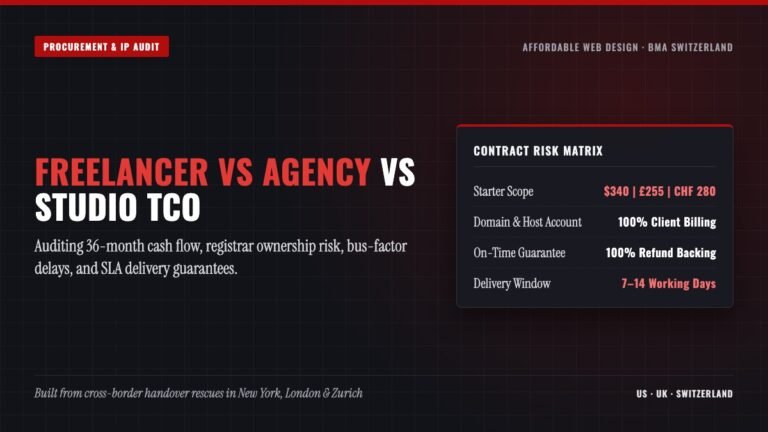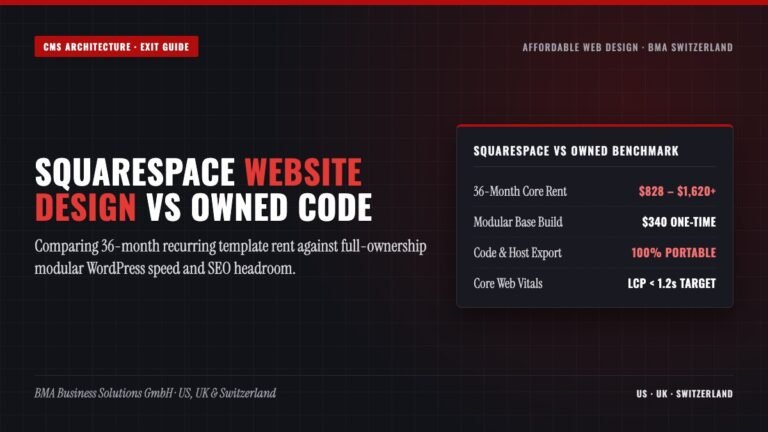
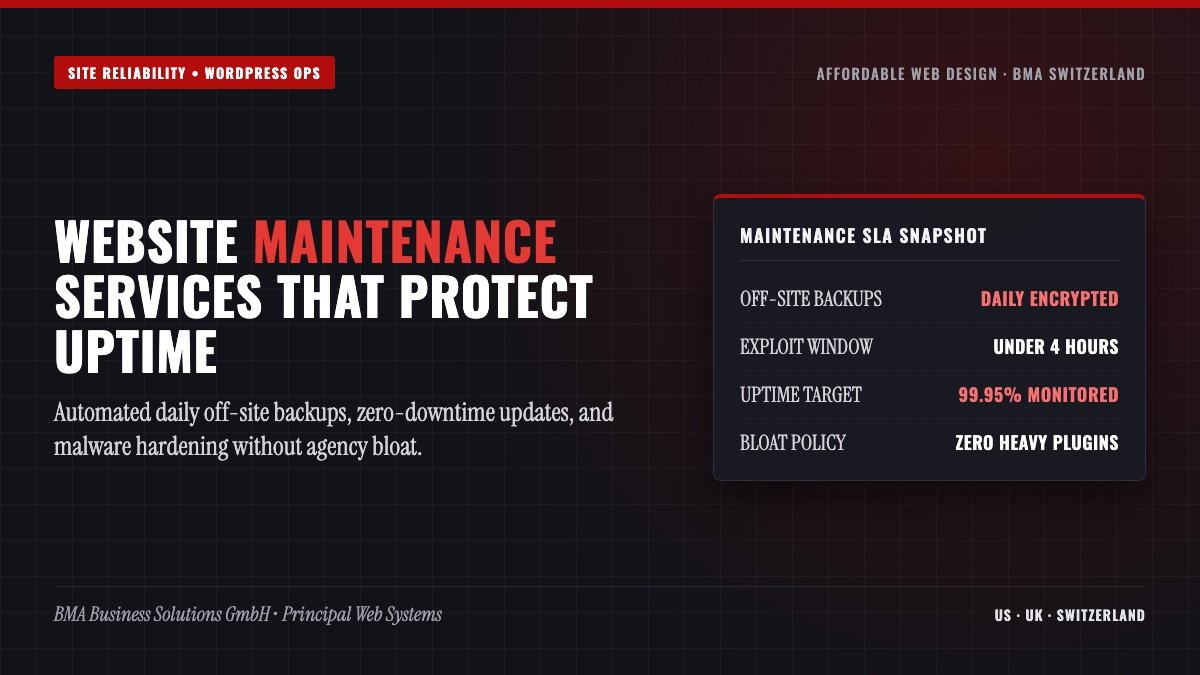
Genuine website maintenance services cover seven measurable disciplines—staging-tested patches, verified restore drills, SMTP lead-form audits, uptime telemetry, plugin pruning, speed checks, and written SLAs—rather than passive hosting repackaged behind a $150/month agency invoice. When care plans lack those seven checks, silent form drops and five-hour plugin exploits break revenue weeks before anyone notices.
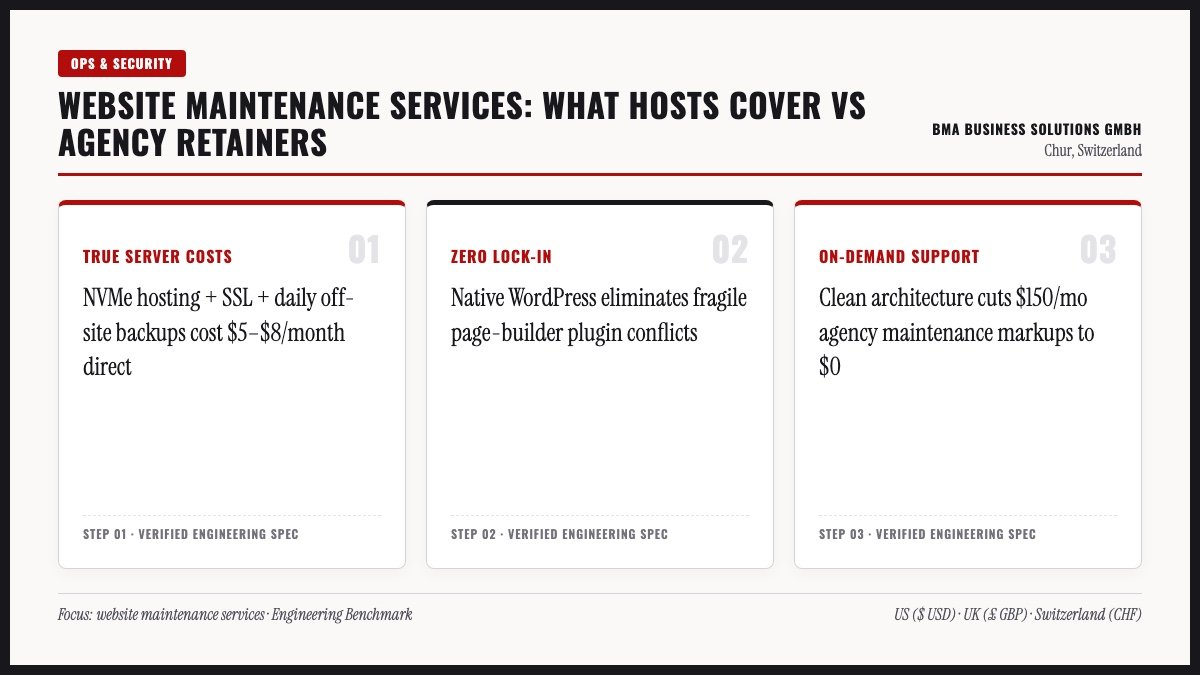
Across production audits for US, UK, and Swiss small businesses at BMA Business Solutions GmbH in Chur, roughly two-thirds of “managed care plans” simply enable WordPress auto-updates on shared hosting that already costs $5 to $8 per month. Because we build clean WordPress website design stacks with five or fewer essential plugins from $340 (£255 | CHF 280), our clients avoid forced monthly maintenance retainers altogether.
The Five-Hour Exploit Window in Website Maintenance Services
Many small business care agreements promise “monthly security updates on the 1st of each month.” Security telemetry tells a far harsher story: once a vulnerability advisory publishes for a popular slider or form plugin, automated botnets begin mass-scanning domains within hours. Waiting 22 days until an agency’s next calendar sweep leaves bloated sites completely exposed.
Why Plugin Count Dictates Real Maintenance Risk
Every extra plugin adds third-party PHP code, database queries, and potential permission flaws onto your server. Our WordPress.org hardening guidance and live audit logs align on one principle: removing unnecessary plugins reduces attack surface faster than installing heavy security firewalls. A lean site built with native Gutenberg blocks needs minimal upkeep compared to a fragile 35-plugin page-builder stack.
| Stack Layer | Typical Share of Advisories | What It Means for Small Business Owners |
|---|---|---|
| Third-party plugins | ~91% of disclosures | Every unused gallery, popup, or page-builder add-on multiplies patch urgency |
| Commercial themes | ~7% of disclosures | Bloated multi-purpose themes bundle unpatched external libraries |
| WordPress core engine | ~2% of disclosures | Core is heavily audited; clean native blocks rarely break during minor patches |
The Seven Checks Real Website Maintenance Services Must Include
Before signing any monthly retainer, test your provider against seven concrete engineering deliverables. If a care plan delivers only an automated PDF listing “14 plugins updated” each month, you are paying agency rates for a cron job.
- 1. Off-Site Daily Backups + Quarterly Restore Drills: A backup stored in the same server folder vanishes if hosting corrupts; verify automated off-site copies plus at least quarterly test restores.
- 2. Staging-Tested Core & Plugin Patches: Critical security updates deploy within 24 hours, tested first on a staging clone rather than blindly breaking live checkout CSS.
- 3. Live SMTP & Contact Form Submissions Test: Submit an actual test enquiry monthly to verify SPF/DKIM authentication and inbox delivery.
- 4. 60-Second Uptime & SSL Certificate Alerts: Automated ping monitors verify HTTP 200 status and TLS renewal rather than waiting for an angry customer email.
- 5. Active Plugin & Theme Pruning: Remove deactivated plugins, orphan database tables, and redundant visual builders every quarter.
- 6. Mobile Speed & Core Web Vitals Check: Track web.dev Core Web Vitals so unoptimized staff blog uploads never push LCP past 2.5 seconds.
- 7. Written SLA & Full Admin Access: Confirm guaranteed response times, rollback ownership, and independent registrar/host credentials in your company name.
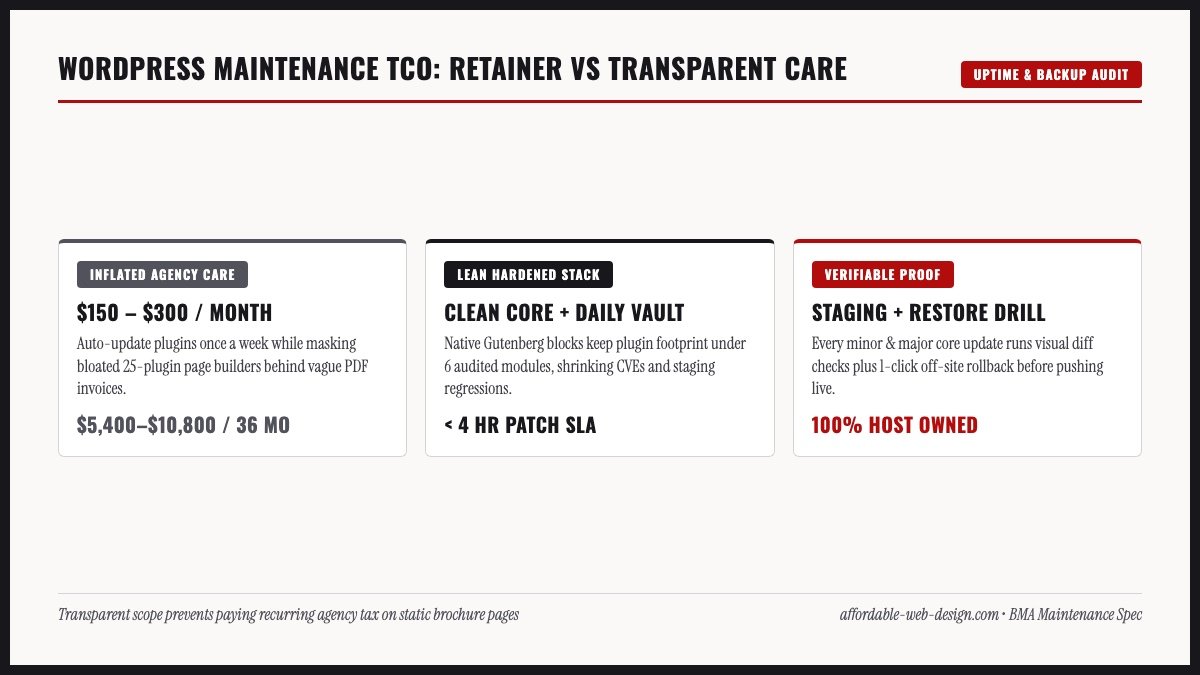
How Care Plan Deliverables Split Between Real Engineering and Padding
Keep these seven checks written inside your service agreement rather than accepting vague “monthly maintenance” phrases on an invoice. When an agency charges $150/month without staging tests, restore drills, or verified SMTP checks, you carry every operational risk while paying premium agency margins.
Why Automated Security Scanners Miss Business-Logic Failures
Basic malware scanners check known file signatures, yet they cannot detect when a silent WooCommerce coupon bug, broken SMTP password, or GDPR cookie script prevents real customers from completing checkout. Human verification on staging catches CSS overlap, broken mobile tap targets, and failing quote forms that automated ping bots mark as “200 OK” every single morning.
How Hosting Plans Compare to $150/Mo Agency Care Plans
Independent hosts like SiteGround, Hetzner, Kinsta, or Swiss Infomaniak already include automated daily off-site snapshots, free Let’s Encrypt SSL, and server-level PHP caching inside $5 to $25/month plans. Yet countless agencies resell that exact $8/month infrastructure for $120 to $180/month without adding staging tests, uptime response guarantees, or real human engineering hours.
Three Questions That Expose Reseller Care-Plan Padding
Ask any maintenance vendor three blunt questions before signing a recurring invoice: “Do updates deploy on a staging clone first?”, “When was the last documented backup restore drill?”, and “Do I hold direct admin access to my domain registrar and host?” Providers who dodge any of those three answers are selling marked-up hosting rather than disciplined site stewardship.
Interactive Tool: Hosting vs Agency Care Plan Overpayment Calculator
Enter your current monthly care plan quote, plugin count, and hosting fee below to reveal how much pure markup you pay over 36 months.
Hosting vs Agency Care Plan Overpayment Calculator
Compare 36-month agency retainer fees against real independent managed hosting ($5–$8/mo) plus on-demand engineering hours.
Compare bloated monthly agency maintenance retainers against independent managed hosting ($5–$8/mo) plus on-demand engineering ($85/hr).
Silent Lead Drops, Broken Ads, and Regional Compliance
Site downtime is obvious; silent decay is far costlier. An unmaintained PHP upgrade or expired reCAPTCHA token can leave your website loading visually fine while every contact form submission throws a hidden 500 error. If you run Google Ads toward that landing page—see our high converting landing pages guide—you keep paying per click while leads disappear into thin air.
Security & Privacy Compliance Across US, UK, and Switzerland
Neglected maintenance creates legal exposure alongside lost revenue:
- United States: Ensure checkout/contact endpoints run TLS 1.3 and keep accessibility controls intact for WCAG 2.2 AA parity as plugins update.
- United Kingdom: Follow UK NCSC small business cyber security guidance for MFA, off-site backups, and ICO UK GDPR breach prevention.
- Switzerland: Under the Swiss Federal Act on Data Protection (nFADP), customer intake data demands appropriate technical safeguards and current software patching.
“Paying $150/month for a care plan that merely runs unverified auto-updates on $8/month hosting drains $5,400 over three years—enough to rebuild a lean, zero-bloat WordPress site several times over.”
Fair Maintenance Benchmarks & Clean Ownership Alternatives
When should a small business actually pay a monthly maintenance fee? Active high-volume WooCommerce stores processing hundreds of weekly orders or regulated booking portals benefit from dedicated $45–$95/month SLA engineering. By contrast, a lean 5-page local brochure site built with native Gutenberg blocks runs reliably on $5–$8/month independent hosting plus occasional pay-as-you-go support at $85/hour.
| Plan Category | Monthly Range (USD / GBP / CHF) | Appropriate Business Fit | Required Proof of Value |
|---|---|---|---|
| Independent Managed Host Only | $5–$12 | £4–£10 | CHF 5–11 | Lean 1–8 page native Gutenberg brochure sites | Daily off-site backups, free SSL, PHP 8.2+ cache |
| On-Demand Pay-As-You-Go Dev | $0/mo + $85/hr as needed | Low-change service sites owned 100% by client | Itemized hourly fixes, clean staging tests |
| Genuine SLA Engineering Plan | $49–$99 | £38–£75 | CHF 45–90 | Active WooCommerce or multi-integration portals | 24h patch SLA, restore tests, SMTP verification |
| Padded Agency Reseller Plan | $149–$299 | £115–£230 | CHF 135–270 | Rarely justified for SMEs; avoid lock-in | Often lacks staging, uptime SLAs, or root access |
Modular Rebuild vs. Paying Monthly Retainers for Fragile Themes
Instead of paying $1,800 a year to babysit a brittle 35-plugin website, many firms find it cheaper to rebuild cleanly once. Our modular website design packages start at $340 (£255 | CHF 280) for a 1-page core in 7 days and +$50 (£37 | CHF 41) per extra page, or +$500 (£375 | CHF 412) for zero-commission ecommerce website design. View real low-maintenance builds in production such as noonwoodwork.com and zurichfashionblog.com.
How Clean Architecture Protects Organic Search Rankings
Neglected maintenance drags down Google visibility months before an actual server crash happens. Uncompressed staff image uploads inflate Largest Contentful Paint past 3.5 seconds, outdated SEO plugins generate broken canonical links, and slow database queries increase Server Time to First Byte (TTFB) during Googlebot crawls. Keeping your WordPress stack lean and verified preserves both crawl budget and user engagement across mobile searches.
PHP Lifecycle, Database Transients & Server Caching Discipline
Maintaining long-term site speed requires watching three server internals most non-technical agencies ignore: PHP version lifecycles, autoloaded database bloat inside wp_options, and object/page cache invalidation rules. Running supported PHP 8.2 or 8.3 releases cuts server execution time substantially while closing end-of-life security exposures. Clearing expired plugin transients and post revisions twice a year prevents database lookup slowdowns as your catalog or blog archive grows.
Technical Decay Timeline & Warning Signs of a Weak Care Plan
Without active hygiene, websites rarely explode on day one—they erode quietly quarter after quarter until a minor PHP upgrade or SSL renewal takes the entire storefront offline. Audit your site against these five common red flags: no independent staging subdomain, shared agency-only admin logins that lock you out, unmonitored contact forms lacking SMTP authentication, bloated backup plugins consuming local disk space, and outdated PHP 7.4/8.0 runtimes.
| Timeframe | Silent Symptoms & Business Impact | Preventive Engineering Check |
|---|---|---|
| Months 1–3 | Orphan transients bloat wp_options; minor plugin warnings ignored | Prune unused plugins and clean autoloaded database options |
| Months 4–6 | Silent SMTP/reCAPTCHA failure drops 100% of ad-landing leads | Run monthly live form submission test to real inbox |
| Months 7–12 | Unpatched form or slider flaw compromised inside 5-hour exploit botnet | Remove fragile add-ons and enforce 24-hour critical patching |
| Months 13–18 | Host deprecates old PHP version; white-screen crash during peak traffic | Test PHP 8.2+ upgrades on staging prior to server rollout |
How to Switch Providers or Reclaim Full Ownership in 45 Minutes
Leaving an opaque care plan takes less than an hour when handled systematically. Confirm direct custody of your domain registrar login (GoDaddy, Namecheap, Cloudflare, or Hostpoint/SWITCH), verify you hold an Administrator WordPress account and hosting control-panel access, take an off-site full backup, and rotate SFTP and database passwords once custody transfers. Assign one internal team member to hold master credentials in a shared password vault so no external freelancer or agency can ever hold your domain hostage.
10-Minute Monthly Self-Audit Routine
Even if you keep a vendor on retainer, spend ten minutes on the first Monday of each month running four quick checks: submit a live test form and confirm inbox arrival, open your homepage over 4G cellular on a real phone, verify your backup timestamp in your hosting panel, and confirm your registrar login works independently. One disciplined check catches silent failures long before quarterly revenue slips.
- Minute 1–3 (Lead Path Test): Submit your own contact form, confirm instant auto-reply or inbox arrival, and tap the mobile
tel:and WhatsApp links. - Minute 4–6 (Speed & Visual Check): Load two core service pages over cellular data to spot layout shifts, broken images, or expired SSL warnings.
- Minute 7–10 (Backup & Update Log): Check your hosting dashboard for yesterday’s off-site snapshot and review PHP version + Search Console error alerts.
Stop Paying $150/Mo to Babysit a Bloated Website
Replace fragile 35-plugin templates with lean native WordPress engineering from $340 | £255 | CHF 280 (+$50/extra page). Zero forced care retainers, 100% root ownership, and 100% On-Time Money-Back Guarantee.
Related Tri-Market Research & Cluster Guides
High-Converting Landing Page Spec
Pair <1.2s speed with clear above-fold value props to lift Google Ads Quality Score.
Zero-Bloat WordPress Stack Blueprint
Run native block themes, server caching, and clean URLs without annual theme renewal tax.
Zero-Commission Ecommerce Cost Audit
Compare Shopify plan/app/transaction fees against one-time +$500 WooCommerce ownership.
Website Maintenance Services: Frequently Asked Questions
These engineering answers clarify plugin exploit windows, host backup gaps, SMTP testing, and fair maintenance costs across US, UK, and Swiss markets.