
Hidden website builder costs turn promotional $16-to-$25 monthly starter ads into $3,000-to-$4,300 three-year expenses while leaving your company with zero transferable code. Once a live business needs appointment scheduling, conditional quote forms, compliant cookie consent, and business email, the entry subscription covers almost none of the daily stack.
In this forensic invoice teardown across the USA, England, and Switzerland, we break down renewal price jumps, app marketplace taxes, commerce surcharges, and mobile speed penalties inside Wix and Squarespace. Compare every line item against our modular website design packages ($340 | £255 | CHF 280 core) and our website cost Switzerland benchmark.
1. The Bait-and-Switch: How Promotional Builder Plans Multiply
Consumer-facing website builder marketing anchors buyers on a simple headline figure—often $16 to $25 per month when billed upfront for a full year. Small-business founders assume that single invoice settles web hosting, email, lead capture, and search visibility for the foreseeable future.
The reality hits at month thirteen. Introductory “50% off first year” pricing expires automatically, pushing the base software fee up 40% to 80% right when your domain, email routing, and Google listings are deeply wired into the platform.
Year-by-Year Renewal Escalation Across US, UK, and Swiss Invoices
Billing friction compounds across currencies. UK SMEs and Swiss firms frequently discover their SaaS invoices carry non-refundable annual prepayments, VAT/MWST adjustments, and separate registrar upsells for domain privacy after year one.
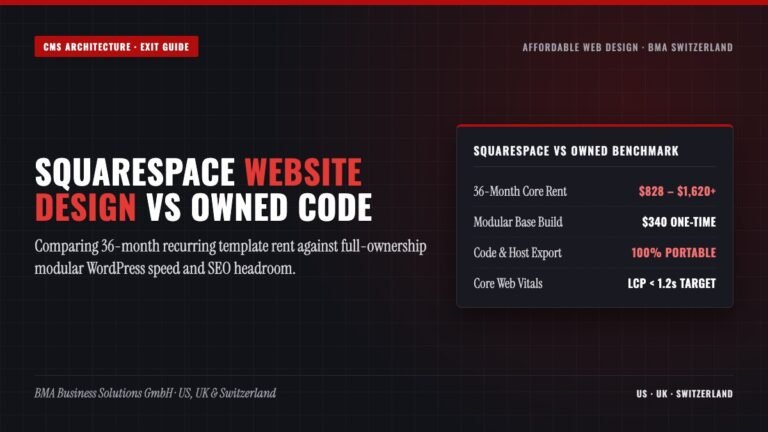
Compare that perpetual software rent against an independent WordPress architecture detailed in our WordPress vs Wix vs Squarespace shootout: once built for a fixed fee, your ongoing overhead drops to ~$10/month commodity hosting you can move anywhere.
Comparing 36-Month Website Builder Costs Across Models
| Cost Component | Wix / Squarespace 36-Mo Reality | Owned Modular WordPress (BMA) | Ownership & Portability |
|---|---|---|---|
| Core Site Build & Platform | $20/mo Yr1 → $38/mo Yr2–3 ($1,152) | $340 core + 4×$50 pages ($540 once) | SaaS: Zero export | WP: 100% your code |
| Independent Hosting & Domain | Bundled inside closed lock-in tier | ~$10/mo indie host + $15/yr domain ($405) | Full FTP/SSH & registrar transfer freedom |
| Bookings, Quote Forms & Cookie Consent | $35–$55/mo third-party app stack ($1,440) | $0/mo native WordPress blocks & open plugins | No per-seat or submission caps |
| Business Email (2 Inboxes) | $12–$18/mo bundled markup ($504) | Direct registrar or Google/M365 wholesale | No vendor margin on email seats |
| 36-Month Cash Total (Service SME) | $3,096 – $3,800+ (ongoing forever) | ~$945 total 3-year cash outlay | Saves $2,150+ with permanent asset equity |
2. The App Marketplace Tax on Basic Business Features
Closed SaaS builders stay visually simple on day one by stripping operational tools out of the core subscription and shifting them into paid app marketplaces. The moment a clinic, salon, or contractor tries to launch real lead workflows, monthly invoices double.
Five Essential Utilities That Trigger Extra Monthly Bills
- Conditional Quote Forms: Multi-step service estimators and file-upload fields routinely force upgrades to $12–$24/month form apps.
- Appointment & Dispatch Calendars: Syncing staff availability with Google Calendar and automated SMS reminders adds $15–$29/month.
- Regional Cookie & Privacy Compliance: Compliant consent blocking under UK ICO PECR, California CCPA/CPRA, or Swiss nDSG frequently pushes owners into paid $10–$18/month compliance widgets.
- Multilingual Routing: Serving German, French, and English buyers cleanly in Switzerland often adds $19–$35/month per language app—versus our one-time +$100 | £75 | CHF 82 + $30/page setup.
- Email Marketing & Seat Markups: Reseller markups on inbox seats and contact-list tiers lock customer data inside proprietary dashboards.

3. The Transaction Cut: Platform Surcharges on Every Sale
Hidden website builder costs hurt retail and service-booking businesses sharpest when online payments switch on. Several entry and mid-tier SaaS plans levy a 2% to 3% platform transaction fee on top of standard Stripe or PayPal processing rates.
On $8,000 in monthly store or booking volume ($96,000/year), a 2.5% platform surcharge quietly extracts $2,400 every twelve months—$7,200 over three years—simply for routing checkout through their template. By contrast, our WooCommerce e-commerce module (+$500 | +£375 | +CHF 412 one-time) runs with 0% platform commission forever, leaving you only direct payment processor fees.
4. The Mobile Speed and Core Web Vitals Penalty
Financial drain is only half the damage; proprietary builders also impose an invisible acquisition tax inside Google Search and Google Ads. Because closed SaaS platforms serve universal runtime frameworks designed to support thousands of visual drag-and-drop widgets, mobile browsers must download and parse massive JavaScript bundles on every page load.
According to the HTTP Archive Web Almanac CMS telemetry and Google PageSpeed Insights benchmarks, bloated SaaS templates frequently lag lean block-based WordPress builds on mobile Largest Contentful Paint (LCP) and Interaction to Next Paint (INP).
| Performance Metric | Typical SaaS Builder Mobile Avg. | BMA Native WordPress Target | Commercial & Ad Impact |
|---|---|---|---|
| Largest Contentful Paint (LCP) | 3.2s – 4.9s on 4G mobile | ≤ 1.8s – 2.4s | Faster paint cuts paid click bounce before headline loads |
| Interaction to Next Paint (INP) | 220ms – 410ms (script queue) | ≤ 90ms – 150ms | Instant menu, filter & quote-form tap responsiveness |
| JavaScript Payload | 900 KB – 2.1 MB bundled | < 180 KB selective scripts | Lowers CPU heat & cellular stall on mid-range phones |
| JSON-LD & URL Control | Restricted / forced /blog/ prefixes | Full custom schema & clean slugs | Supports AI Overviews & /local-seo-ranking-study/ alignment |

Interactive TCO Audit: Calculate Your 3-Year Builder Drain
Select your region, current SaaS builder tier, required apps, and monthly online sales volume below to model your exact 36-month cash outflow against an owned modular WordPress build.
Wix & Squarespace 36-Month Renewal & App Creep TCO Calculator
Audit what promotional builder tiers actually cost over three years once renewal jumps, paid booking/form apps, email seats, and card fees stack up.
5. Tenant vs. Owner: The Real Cost of Escaping a Closed Ecosystem
Every month spent adding pages, blog posts, and galleries inside a closed builder increases your eventual switching cost. Unlike open WordPress—where your entire site database and theme files zip cleanly in five minutes—Wix and Squarespace offer no native full-site theme or layout export.
When a growing firm hits speed limits, SEO URL restrictions, or renewal shock and decides to leave, they face a manual rebuild plus careful 301 redirect mapping to protect search rankings. Evaluating freelancer vs agency ownership models early keeps your business out of tenant software traps altogether.
How Closed Builders Inflate Google Ads and Local Acquisition Costs
Every extra second your mobile landing page spends parsing proprietary builder JavaScript increases bounce rates before a visitor reads your offer. According to web.dev Largest Contentful Paint benchmarks, keeping mobile primary paint under 2.5 seconds protects user engagement across paid and organic channels.
When a Wix or Squarespace page takes 4.2 seconds to paint over 4G cellular networks in suburban Atlanta, Manchester, or Zurich, Google Ads Quality Score drops and cost per lead climbs. Moving the exact same ad spend onto a lean native WordPress page regularly cuts wasted click spend inside the first thirty days.
The High Price of Manual Rebuilds When Leaving a Closed Platform
Because proprietary builders lock page layouts inside closed cloud templates, switching platforms later forces a manual rebuild of every page, gallery, and form. If a 12-page business site waits until year three to escape, paying an agency $2,500 to $5,000 for a rescue migration wipes out every dollar supposedly saved during month one.
Starting on open, portable WordPress—as shown across our live agency portfolio and properties like allea.ch and zurichfashionblog.com—eliminates forced rebuild taxes permanently. You can move your entire database between any US, UK, or Swiss host in under an hour.
Tri-Market Legal Compliance Traps Inside Closed SaaS Templates
Regional privacy and accessibility mandates add extra subscription costs inside proprietary builder ecosystems. In England, UK GDPR and PECR rules require blocking non-essential analytics and ad tags until visitors give affirmative opt-in consent—something default free builder banners often fail to enforce without a paid third-party widget.
In the United States, state privacy statutes like California CCPA/CPRA and ADA WCAG 2.1 AA keyboard-navigation requirements punish locked SaaS themes that omit ARIA focus states. In Switzerland, Swiss nDSG transparency rules and multilingual cantonal buyer journeys penalize platforms charging extra monthly subscriptions per translated site version.
Founder Time and Economic ROI: 36-Month Exit Checklist
- Audit Current Monthly SaaS Spend: Sum base hosting renewal, booking widgets, conditional forms, cookie banners, and builder email markups.
- Verify Registrar Ownership: Confirm your domain sits inside your own registrar account rather than inside Wix or Squarespace billing.
- Map Every Ranking URL: Export top Search Console URLs so 301 redirects preserve 100% of existing equity during migration.
- Launch Owned Modular WordPress: Move to a fast $340 | £255 | CHF 280 core (+$50/extra page) on independent US, UK, or Swiss hosting in 7–14 working days.
Comparing SaaS Email Markups vs. Independent Hosting
Business email is another overlooked line item in total website builder costs. Many entry Wix and Squarespace flows bundle Google Workspace or Zoho seats through a reseller markup while charging separate domain renewal uplifts after the first year.
When you host an open WordPress build on independent US, UK, or Swiss infrastructure, you separate registrar, DNS, email, and web hosting cleanly. If one supplier raises renewal prices arbitrarily, you migrate your WordPress archive in minutes without touching company email routing or losing search rankings.
Modular Fixed Pricing and Contractual Protection
At BMA Business Solutions GmbH, you pay once for clean engineering and own 100% of the asset from day one: $340 | £255 | CHF 280 for a 1-page core (4 hours at $85/hr) live in 7 working days, +$50 | +£37 | +CHF 41 per extra page (2–7 pages live in 14 working days), +$500 | £375 | CHF 412 for 0%-commission WooCommerce, +$100 | £75 | CHF 82 (+$30/pg) for multilingual, and $255 | £190 | CHF 210 one-time Turnkey Local SEO—all backed by our 100% On-Time Money-Back Guarantee.
Every build includes clean domain and hosting setup under your own legal name, verified mobile Core Web Vitals performance, and zero recurring platform lock-in. Whether you operate in Chicago, Manchester, or Chur, your website becomes a permanent company asset rather than a monthly software liability, with transparent written milestones from start to launch.
“Promotional $20/month website builder ads mask a three-year invoice exceeding $3,200 once renewal jumps, booking apps, email seats, and transaction fees stack up—and if you stop paying rent, your entire site vanishes from Google.”
Stop Paying Perpetual Software Rent on Your Company Website
Trade escalating Wix or Squarespace renewal bills for a fast, owned WordPress site starting at $340 | £255 | CHF 280 (+$50/extra page) delivered in 7–14 working days with zero platform lock-in. Message us on WhatsApp to plan a zero-downtime migration.
Related Tri-Market Research & Cluster Guides
Website Cost Switzerland (CHF Benchmark)
Compare Chur CHF 280 fixed builds and hreflang costs against CHF 3,500–12,000 agency retainers.
WordPress vs Wix vs Squarespace Shootout
Identical 5-page test builds benchmarked on LCP, INP, JSON-LD flexibility, and 36-month bills.
Freelancer vs Web Design Agency Audit
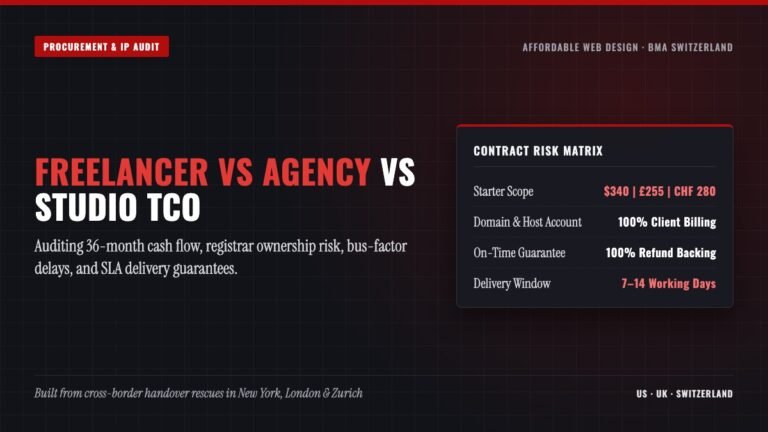
Evaluate domain custody clauses, bus-factor stalls, and 36-month TCO side by side.
Frequently Asked Questions: Hidden Website Builder Costs
These answers address renewal pricing jumps, app marketplace fees, migration equity, and fixed-price owned WordPress alternatives.