There is a dangerous illusion sold to small and medium enterprises (SMEs) across the five boroughs: the belief that to compete in New York City, you must purchase a $50,000 digital art project from a prestigious Manhattan agency. In the algorithmic reality of 2026, this “Madison Avenue Premium” is not just a misallocation of capital; it is actively destroying your local search visibility.
Google’s machine learning algorithms—obsessed with Core Web Vitals, Interaction to Next Paint (INP), and hyper-local spatial rendering—do not care about your agency’s zip code, their espresso machine, or their complex 3D WebGL scroll animations. They evaluate the structural integrity of your code. When a prospective client searches for your services while on a degraded 4G connection entering the MTA subway system, your website has exactly 1.5 seconds to render and answer their query. If it fails, they bounce to your competitor.
To dominate the NYC digital landscape, you must stop treating web design as an exercise in graphic design and start treating it as an exercise in structural engineering and behavioural psychology. You are building digital real estate in the most densely populated market in America. Your architecture must be flawless.
This masterclass deconstructs the exact, unvarnished frameworks that elite conversion engineers use to turn passive New York traffic into captured revenue. We will expose the technical debt of legacy agencies, map the psychology of the NYC commuter, and reveal the exact semantic SEO blueprints required to dominate spatial search from Tribeca to Astoria.
Chapter 1: The Spatial Search Matrix (Hyper-Local NYC SEO)
The phrase “NYC SEO” is fundamentally obsolete. New York is not a single city in the eyes of Google’s algorithm; it is a dense, overlapping network of hundreds of micro-neighborhoods. If a user is standing in SoHo and searches for a commercial service, Google’s spatial algorithm filters results based on exact GPS proximity, topographical boundaries, and localized Entity Salience.
You cannot simply write “Serving all of New York City” on your homepage and expect to rank. You must execute architectural, entity-based SEO that proves your relevance to specific boroughs and streets.
Engineering the NYC Knowledge Graph
Legacy agencies will attempt to rank your site by creating fifty different “City + Service” pages (e.g., “Plumber Brooklyn,” “Plumber Queens”) using duplicated, spun content. Google’s 2026 Helpful Content classifiers instantly flag this as spam and suppress the entire domain. Elite digital architecture for New York small businesses relies on robust, dynamic Information Gain and semantic schema.
- Nested Geo-Coordinates: We inject raw, machine-readable
JSON-LD LocalBusinessschema directly into the<head>of your site. This maps your exact physical longitude and latitude, intersecting it with targetedareaServedpolygons (e.g., specific Manhattan zip codes) to dominate “near me” micro-queries. - Local Entity Linkage: We use
SameAsschema properties to mathematically link your website to verified NYC trust nodes—such as your official NY Department of State business registration, your local Chamber of Commerce profile, and highly authoritative NYC digital PR placements. - Hyper-Local Proof points: Instead of stock photos of the Empire State Building, high-ranking pages embed dynamically generated, geo-tagged case studies of actual work completed in specific neighborhoods, satisfying the algorithm’s demand for real-world authenticity.
Stop Paying the Madison Avenue Premium
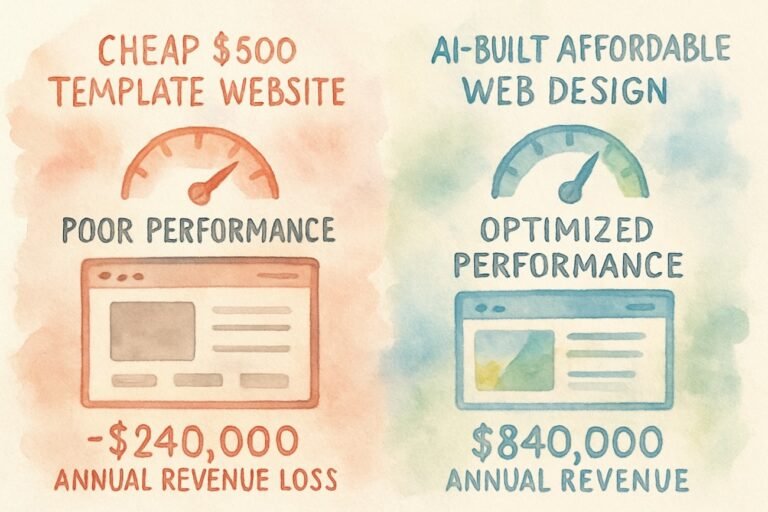
Why pay $50,000 for a bloated template that fails Google’s speed tests? Partner with structural web architects who build high-performance, natively coded digital assets for a fraction of the cost.
Chapter 2: The Core Web Vitals Tax and the Commuter UX
There is a massive disconnect between how web designers in pristine offices view a website on a 5K retina monitor over gigabit fiber, and how actual New Yorkers experience that website. Over 75% of local commercial searches in NYC occur on mobile devices, often while the user is in motion—walking down a crowded avenue or relying on intermittent cellular service on the subway.
The Death of DOM Bloat
When a “luxury” agency builds a site using a heavy drag-and-drop page builder (like Elementor or Divi) to achieve complex visual effects, they generate massive Document Object Model (DOM) bloat. This means thousands of lines of unnecessary code must be downloaded and parsed by the user’s mobile CPU.
In 2026, Google strictly enforces the Interaction to Next Paint (INP) metric. If a commuter taps a button on your site and there is a 400-millisecond delay because their phone is choking on your agency’s heavy JavaScript animations, you fail the Core Web Vitals test. Google actively demotes failing sites in the NYC local pack, prioritizing brutalist, lightweight architectures that render instantly.
The Commuter Drop-Off: Mobile Render Speed vs NYC Conversion Rate
Wayfinding and the “Thumb Zone”
Grand Central Terminal is a masterpiece of spatial wayfinding, moving three-quarters of a million people daily without chaos. Your mobile layout must execute the same logic. We map the “Mobile Thumb Zone.” Critical navigational vectors, click-to-call buttons, and conversion triggers are physically removed from the top of the screen (which requires two hands to reach on modern smartphones) and anchored to the bottom edge of the viewport. This frictionless, one-handed UX instantly boosts conversion rates among active commuters.
Chapter 3: Cognitive Friction and the Psychology of the Landing Page
New Yorkers do not have the patience to decipher your creative vision. When they land on your website, they are in a micro-moment of high commercial intent. They have a specific problem (e.g., a burst pipe, a legal dispute, a need for corporate catering), and they are ruthlessly scanning your page to determine if you possess the solution. If your design creates cognitive friction, they will close the tab.
Hick’s Law and Ruthless Essentialism
Elite conversion engineers leverage Hick’s Law, which states that the time it takes for a person to make a decision increases logarithmically as the number of choices increases. Traditional designers love massive top navigation bars with 15 dropdown links. To a conversion engineer, every one of those links is an exit door. To truly master the mathematics of high-converting landing pages, you must practice ruthless essentialism.
We strip away the main navigation on high-intent service pages. We remove the clutter. We present the user with a singular, high-contrast Value Proposition and exactly two options: convert (Primary CTA) or learn more (Ghost CTA). This forced funneling respects the user’s time and can mathematically double lead generation rates without increasing your ad spend by a single dollar.
Chapter 4: The Matrix: Commodity Design vs. Structural Engineering
To ensure you are allocating your capital correctly in the NYC market, you must understand the exact mechanical differences between a commodity design sold by a legacy agency and a natively coded structural asset.
Is Your Current Website Structurally Deficient?
A beautiful website is useless if it fails to convert NYC traffic. Let our digital architects audit your current code and map a high-ROI migration strategy.
Chapter 5: Un-copyable Local Authority (The Entity Moat)
Publishing generic blog posts about “Why you need a lawyer in NYC” will yield exactly zero traffic in 2026. The internet is flooded with AI-generated commodity content. Google’s algorithm has responded by dramatically increasing the threshold for what it considers “Helpful Content,” actively seeking out Information Gain.
To build an un-copyable local content moat, you must extract the proprietary data trapped inside your business. If you are a commercial HVAC contractor, do not write a generic post about air conditioning. Publish a highly specific, data-backed Pillar Page detailing how you retrofitted a pre-war building in the Upper West Side to meet Local Law 97 emissions standards, including actual cost reductions, real-world constraints, and localized schema markup.
This level of radical transparency combined with technical execution is how you establish absolute hyper-local Google Business Profile prominence. It proves undeniable E-E-A-T (Experience, Expertise, Authoritativeness, and Trustworthiness) that no AI tool or offshore competitor can replicate.
Executive Summary: The 2026 NYC Mandate
The era of treating a New York City website like a digital brochure is permanently over. In a landscape governed by brutal Core Web Vitals metrics, AI Overviews, and hyper-local spatial search, your underlying architecture is everything. Paying a legacy agency a massive premium for a bloated template is a direct tax on your future revenue. True commercial dominance requires investing in lean, semantic, natively coded engineering that respects the commuter’s time, masters the local Knowledge Graph, and mathematically forces conversions.
The NYC Web Design Master FAQ
Why does a custom “architectural” website cost more than a Wix template?
You are not paying for the visuals; you are paying for the engineering and the commercial strategy. A SaaS builder template is bloated with thousands of lines of unused, proprietary JavaScript, severely throttling its ability to rank on Google due to poor mobile render speeds. A custom architectural build is natively coded, fully owned by you (no vendor lock-in), and engineered specifically to capture organic search real estate. It is a revenue-generating asset, not an operational expense.
Can I use a Virtual Office in Manhattan to rank in NYC Local Search?
Absolutely not. Google’s algorithm has aggressively clamped down on businesses using Regus or WeWork virtual mailboxes to manipulate local search. If multiple unrelated businesses share the exact same suite number, Google will flag the addresses and suspend the Google Business Profiles. If you serve NYC but are based in New Jersey or Long Island, you must execute a strict Service Area Business (SAB) strategy, using precise geo-polygons and local digital PR to build spatial relevance without faking an address.
What does “Mobile-First Architecture” actually mean for New Yorkers?
It means the design process physically begins on the smallest viewport. We do not design a massive desktop site and try to “squish” it down onto a phone. We map the core user journey, structure the thumb-zone navigation, and prioritize the DOM rendering path specifically for a mobile device on a degraded 4G connection (like inside a subway car). Only once the mobile conversion funnel is perfectly rigid do we expand the architecture for desktop screens.
Why are ADA compliance and WCAG accessibility so critical in NYC?
Beyond the moral imperative of ensuring your site is usable by the 20% of the population with disabilities, NYC is the epicenter of predatory ADA website compliance lawsuits. If your website lacks proper semantic ARIA tags, relies on low-contrast typography, or cannot be navigated entirely via a keyboard, you are a prime target for costly litigation. Elite digital architecture natively bakes WCAG 2.2 AA compliance into the code from day one, mitigating legal risk while actively boosting semantic SEO.
NYC competition is real — and generic websites don’t survive it. See our affordable web design for small businesses built to compete in high-cost markets.
In a market as competitive as New York, design alone does not cut through. See our affordable SEO services and how we pair performance web design with search visibility.