Note: This post was written based on the incredible insights from the interview “How $18K in SEO Turned Into $1.7M for a Garage Door Company” featuring Sarvesh Shrivastava on The Edward Show.
Generating leads in the local home services industry is notoriously brutal. At Affordable Web Design Agency, we constantly speak with business owners who feel trapped in a cycle of buying shared, low-quality leads from third-party directories. You compete on price, race to the bottom, and struggle to scale your operations.
What if you could completely own your lead generation pipeline?
Recently, SEO expert Sarvesh Shrivastava broke down a massive achievement on The Edward Show. He revealed how a struggling garage door company transformed an $18,000 marketing investment into $1.7 million in highly profitable revenue within just 11 months. This phenomenal growth was not an accident. It was the result of a precise, execution-focused Garage Door SEO Strategy.
This guide is your ultimate roadmap. Whether you fix garage doors or install HVAC systems, this Google My Business optimisation Blueprint for Home Services will show you exactly how to build an organic revenue engine. Let’s break down the system step by step.
The Reality of SEO ROI for Local Business
Projected Monthly Leads
Projected New Customers
Projected New Revenue
Many business owners treat SEO as an abstract expense rather than a measurable investment. They pay a monthly retainer, receive a confusing report filled with traffic metrics, and wonder why their phones are not ringing.
Traffic without intent is completely useless. You cannot deposit pageviews into your bank account.
This specific Local SEO Case Study proves that when executed correctly, search engine optimization offers the highest return on investment of any marketing channel. By targeting high-intent local searches, this company stopped competing for top-of-funnel traffic and focused entirely on users ready to buy. The mathematical proof is undeniable when looking at the $1.7M generated from an $18K investment.
The strategy relies on systematic execution across four distinct phases. Here is exactly how they did it.
Phase 1: Dominating the Google Business Profile (GBP)
Most local businesses make a fatal error on day one. They pour their entire initial budget into a flashy, expensive website redesign without considering how users actually find them.
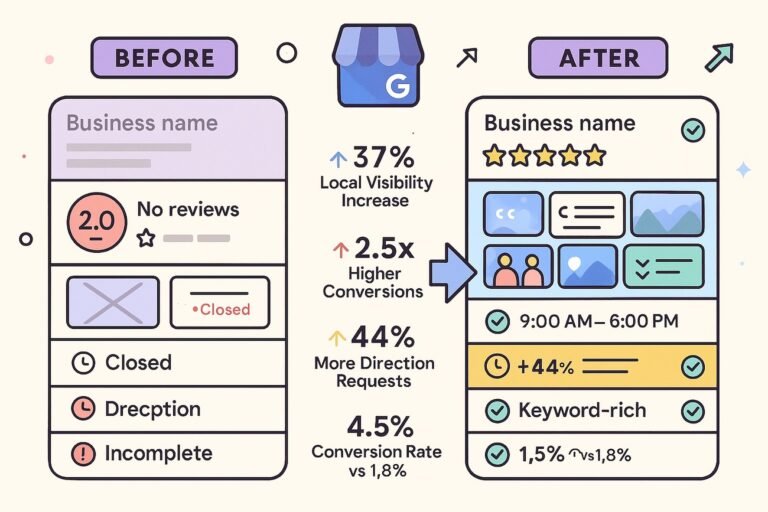
Your website matters, but your Google Business Profile (GBP) is your most vital asset at the start of a campaign. When a homeowner searches for emergency repairs, Google displays the Local Pack (the map and three business listings) at the very top of the results. If you are not in that pack, you are invisible to high-intent buyers.
Auditing and Systematizing Reviews
Review Velocity vs. Local Pack Ranking
Consistent weekly reviews drastically improve your Local Pack ranking over time. Move the slider to see the correlation between review growth and higher map placements.
Reviews are the lifeblood of local WordPress SEO. However, the total number of reviews is only part of the equation. Google’s algorithm closely monitors your review velocity.
Review velocity is the consistent, natural speed at which new reviews hit your profile. Gaining 50 reviews in one week and zero for the next six months looks highly suspicious and can actually harm your rankings. You need a steady, predictable flow of positive customer feedback.
To achieve this, you must build a bulletproof team system. Do not leave reviews to chance. Empower your field technicians to ask for reviews the moment a job is successfully completed. Give them a simple script and ethically reward technicians who consistently generate five-star reviews mentioning specific services.
Optimizing Profile Details and Categories
Business owners frequently mishandle the technical setup of their GBP. Choosing the right primary and secondary business categories dictates whether you show up for profitable searches.
You must be brutally specific. If you only select a broad category, you will lose to competitors who selected niche, high-intent categories matching the user’s exact problem. Review your competitor’s categories and ensure your profile mirrors the most profitable search intents.
Furthermore, visual trust drastically impacts conversion rates. Stop using stock photos of generic houses and smiling models. Real, authentic photos of your branded trucks, your actual team members, and your completed jobs will consistently outperform polished stock imagery. Trust is the ultimate currency in local home services.
Phase 2: Architecting a Revenue-Focused Website
Once your Google Business Profile is properly optimized, your focus must shift to the website. Your website has one primary job. It must capture local search traffic and convert those visitors into inbound phone calls.
Many business owners build websites that act as digital brochures. They list services, provide an “About Us” page, and hope for the best. This passive approach completely kills your SEO ROI for Local Business.
The Death of Generic Service Pages
One of the most critical takeaways from this Garage Door compact keywords strategy.
A single page titled “Our Services” that attempts to rank across five different cities simply does not work anymore. Google wants to provide users with highly relevant, localized solutions. A cookie-cutter page cannot compete with a competitor who has dedicated, hyper-focused pages for each specific area.
If you rely on one broad page to drive all your traffic, you will lose your rankings to more relevant competitors.
Building High-Converting Money Pages
Revenue Growth vs. Page Publishing
Staggered publishing of location and service pages builds topical authority. Watch how consistent content deployment compounds into massive revenue growth over 11 months.
Instead of generic pages, you must construct dedicated "service + location" money pages. These are the pages that actually drive revenue.
For example, a highly optimized page would be titled "Garage Door Spring Repair in Chicago." This page speaks directly to the searcher's exact problem and their exact location. When a user lands on this page, they instantly know they are in the right place.
If your business serves multiple cities or counties, your URL structure is critical. You must organize your site architecture to reflect these territories without cannibalizing your own rankings. A clean structure often looks like /service-name/city-name/.
Keep your publishing velocity steady. Pacing the release of these money pages is crucial to maintaining Google's trust. Dumping 500 automatically generated location pages onto your site overnight will trigger spam filters and ruin your domain authority.
Phase 3: Building Local Topical Authority
Blogging for a local business is vastly misunderstood. Plumbers and garage door technicians do not need to write lifestyle blogs to go viral on social media.
The primary goal of local content is not to generate millions of national pageviews. Your goal is to build "topical authority" within your specific geographic area. You want Google to view your domain as the absolute most knowledgeable entity regarding your specific trade in your city.
Supporting the Money Pages
Local blog posts exist strictly to support your "service + location" money pages.
If your main money page targets garage door repair in your city, your supporting content should answer specific, local questions. Write about how the local winter weather affects garage door springs. Write about local building codes for new door installations.
These informative articles capture users in the research phase and push them toward the commercial investigation phase.
Internal Linking Silos
To pass maximum SEO value from these informational posts to your revenue-generating pages, you must master internal linking.
An internal linking silo connects related content tightly together. Every time you write a supporting blog post, you must include a highly relevant internal link pointing directly back to the corresponding "service + location" money page. This structure helps search engine crawlers understand which pages are the most important. It funnels the authority directly to the pages that make your phone ring.
Focusing Exclusively on High-Intent Searches
Stop chasing national vanity keywords. Trying to rank for broad terms like "how a garage door works" will attract readers from across the country. Those readers will never hire you.
Stick exclusively to high-intent local keywords. Prioritize your content creation based on the actual revenue potential in your specific market. Furthermore, ignore the "near me" myth. You do not need to unnaturally stuff phrases like "garage door repair near me" into your paragraphs. Google's algorithm uses the searcher's IP address and location data to automatically serve local results.
Phase 4: A Bulletproof Local Link Building Strategy
Off-page SEO remains a massive driver of organic rankings. Backlinks act as digital votes of confidence. The $1.7M revenue leap in this case study relied heavily on a careful, quality-first link building strategy.
Many UK local SEO agency buy hundreds of cheap, toxic links to artificially inflate numbers. This strategy is dangerous and often results in severe manual penalties.
Quality Over Quantity
A handful of highly authoritative, relevant links will always outperform dozens of weak ones. Avoid link farms, spammy directories, and low-quality guest posting sites.
When you build or earn links, evaluate the true authority and relevance of the referring domain. A link from a local homebuilder's website is incredibly valuable. A link from a random, foreign tech blog is entirely worthless to a local home service company. Focus on relevance.
Hyperlocal PR Outreach
The absolute best way to build top-tier local authority is by earning links from local news organizations.
You must develop a hyperlocal PR outreach strategy. Pitch compelling stories, community involvement, or unique business updates to local journalists. Did your team donate services to a local community center? Did you release data on the most common home repairs in your county? Pitch it.
The fortune is always in the follow-up. Journalists are busy. Sending a single email will rarely secure a placement. Politely following up a few days later is often the key to getting your story featured and securing that incredibly powerful local backlink.
Networking and Local Swaps
Beyond traditional media, real-world networking translates beautifully into SEO.
Build genuine relationships with other non-competing home service businesses in your area. If you fix garage doors, partner with local painters, roofers, and landscapers. You can safely and effectively exchange links or guest posts on each other's websites. This builds a powerful local network of relevance that search engines love.
Adapting the Blueprint for Other Home Services
While this specific case study focused on a Garage Door SEO Strategy, the underlying principles apply universally.
This is the definitive Local SEO Blueprint for Home Services. Whether you are an HVAC technician, a roofing contractor, or an emergency plumber, the formula remains exactly the same.
- Optimize your Google Business Profile for review velocity and visual trust.
- Build specific "service + location" pages to capture high commercial intent.
- Establish topical authority with localized supporting content and internal silos.
- Drive power to those pages through hyperlocal PR and relevant link building.
By treating your website as a revenue engine rather than a digital brochure, you can achieve life-changing business transformations. It takes patience, discipline, and expert execution to pull it off.
FAQ Section
How long does it take to see an ROI from Local SEO?
Local SEO typically takes 3 to 6 months to start showing significant movement in rankings, and 6 to 12 months to generate a massive return on investment, as seen in the 11-month timeline of this case study.
Are generic service pages bad for SEO?
Yes, generic service pages that try to rank for multiple cities usually fail. Google prefers specific "service + location" pages that directly answer a user's exact query in their specific area.
How important is my Google Business Profile?
Your Google Business Profile is critical. It determines your presence in the Local Map Pack, which is the very first thing mobile users see when searching for local home services.
Do I need to put "near me" in my website text?
No, stuffing "near me" into your content is a myth. Search engines automatically use the searcher's geographic location to provide the best local results.
Start Dominating Your Local Market Today
You now have the exact blueprint that turned a modest budget into a seven-figure revenue stream. Stop relying on shared leads and start building an organic asset that pays you back every single month.
Implementing this system requires technical precision, beautifully structured web architecture, and an unyielding commitment to SEO best practices. If you are ready to transform your lead generation but want an expert team to handle the heavy lifting, Affordable Web Design Agency is here to help. Explore our affordable SEO services for small businesses today to turn your website into a reliable revenue engine.
reference
The revenue outcomes in this case study started with a professionally built foundation. See our small business web design services — the same approach, ready for your business.