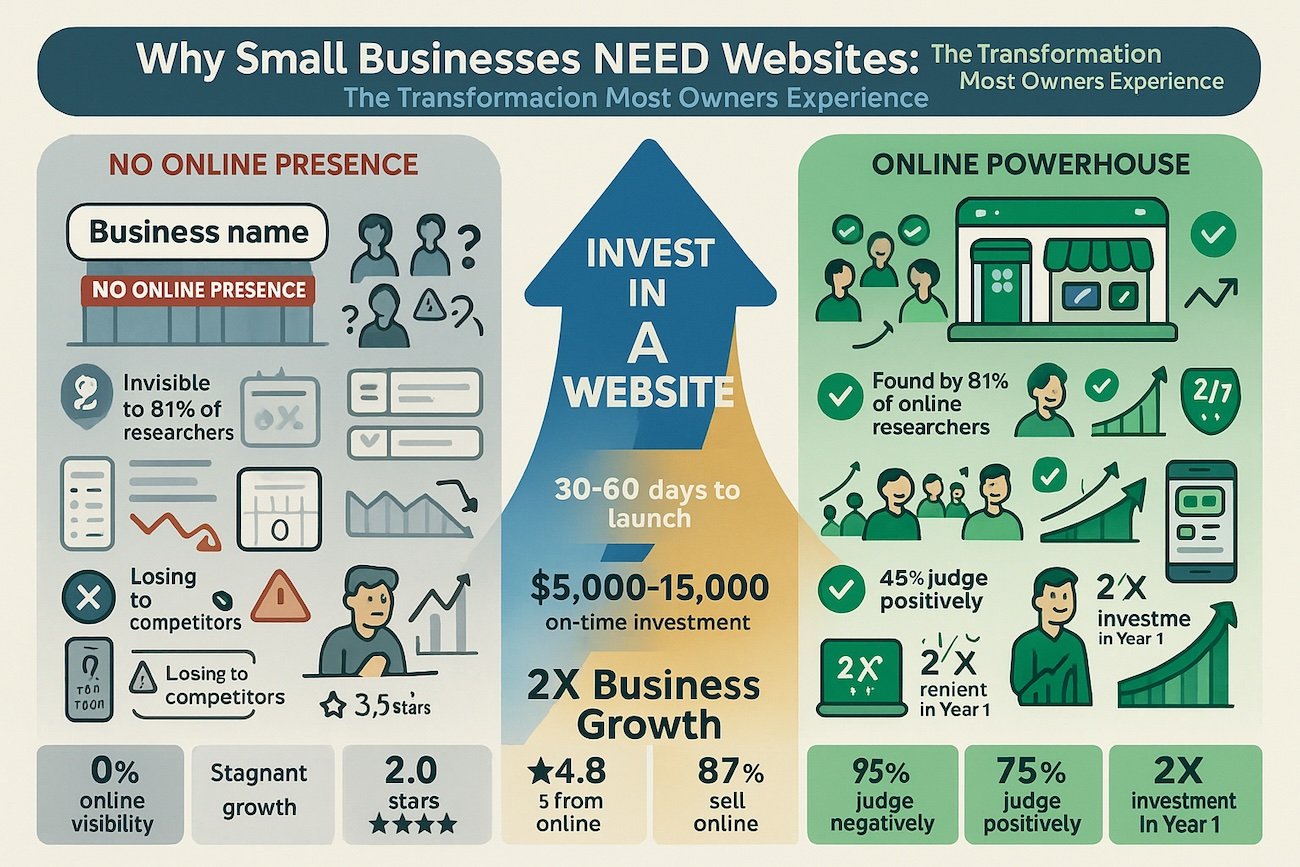
Here’s the brutal truth: 62% of consumers will ignore your business if you don’t have a website. Yet many small business owners still believe their business is “too small” or that social media is “enough.” They’re leaving revenue on the table. Small businesses with websites grow 2X faster than those without, capture 81% of consumers actively researching online, and command 84% higher trust from potential customers.
Your competitors already grasped this lesson. Being online isn’t optional—it’s their baseline. Visibility translates into captured customers and growing market share. Still sitting on the sidelines? This guide demolishes every excuse blocking your progress and explains exactly why cleaning company website design in 2025.
The Crushing Reality: Why Small Businesses Without Websites Lose
71% of small businesses now have a website. That statistic seems reassuring until you realize the inverse: 29% of small businesses remain completely invisible online. These businesses are essentially surrendering market share to competitors who understand one fundamental truth: your customers are searching for you online before they visit, call, or make a purchase.
The data doesn’t lie. Consider these sobering facts:
81% of consumers research a business online before making any purchase decision. If your business isn’t online, you’re not being researched. You’re not being compared. You’re simply not in the conversation. Meanwhile, competitors appear in search results, Google Maps, and social media feeds—capturing mindshare and market share simultaneously.
75% of consumers judge a business’s credibility based entirely on website design. Your website isn’t just information storage—it’s your credibility engine. Within the first 0.05 seconds, visitors form opinions about your business. That’s less time than a human blink. A professional website signals competence, legitimacy, and investment in customer experience. Absence of a website? It signals you’re not serious about your business.
87% of small businesses sell something on their websites. Whether you’re a service provider, retailer, consultant, or creator, your website becomes an additional revenue channel operating 24/7. Customers who can’t reach you by phone can contact you through your website. Orders placed at midnight still generate revenue tomorrow morning.
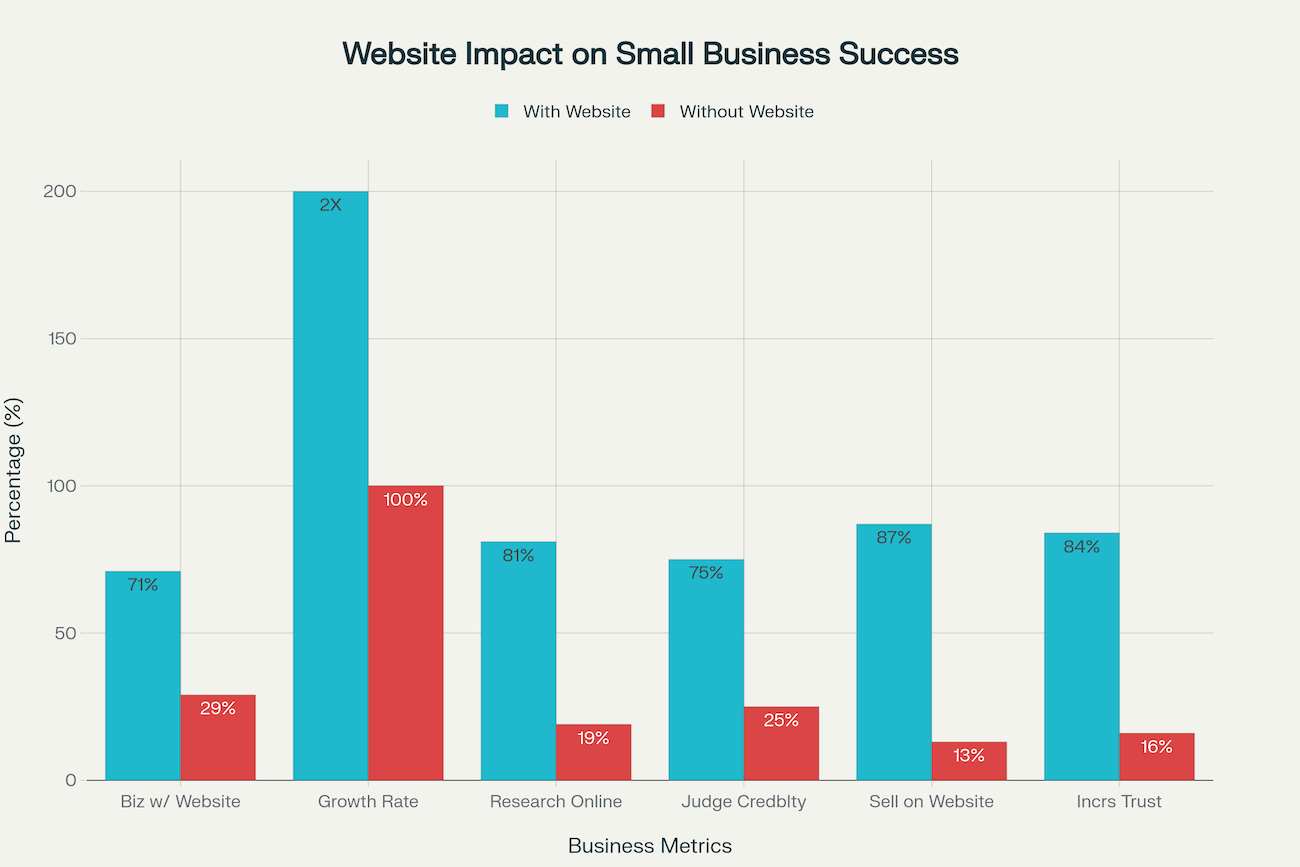
The undeniable impact of small business websites: Companies with online presence grow twice as fast, build significantly more customer trust, and capture the majority of consumer research and purchasing decisions
The Growth Multiplier Nobody Talks About
Here’s the metric that changes everything: Small businesses with websites grow 2X as fast as those without. This isn’t a marginal improvement—it’s fundamental business acceleration.
Why? Because a website compounds your advantages:
Constant Lead Generation: While you sleep, eat lunch, or attend to other customers, your website answers common questions, collects contact information, and moves prospects through the sales funnel. 24/7 availability is a permanent competitive advantage.
Search Engine Visibility: When someone searches “plumber near me,” “accounting services,” or “[your service] in [your city],” your website can appear. Businesses without websites? Invisible. Over time, this visibility compounds into dramatically accelerated growth.
Customer Confidence: Prospects comparing you to competitors now have quantifiable reasons to choose you. Your website showcases testimonials, displays certifications, explains your process, and demonstrates why you’re worth choosing. This confidence translates directly into conversion rate improvements.
Reduced Sales Friction: Potential customers can learn about your services, see pricing, schedule appointments, and submit inquiries without calling during business hours. This removes friction from your sales process, converting casual interest into qualified leads.
The growth multiplier emerges from compounding these advantages month after month, year after year.
Trust: The Currency That Drives Purchasing Decisions
88% of consumer buying decisions are influenced by trust. This statistic should dominate your strategic thinking. Trust isn’t secondary to products or pricing—it’s primary. Without trust, conversions collapse.
Here’s what’s remarkable: Your website is your primary trust-building tool. More than social media, more than referrals, more than testimonials scattered across Google Maps. Your website is where prospects make their credibility judgment.
83% of consumers form their opinion about a website in under 20 seconds. Your design matters immensely. A clean, professional website conveys competence and trustworthiness. A cluttered, outdated, or mobile-unfriendly site signals the opposite. This first impression becomes the foundation for everything that follows.
84% of consumers say a business website increases their trust. But here’s the critical nuance: this trust emerges from quality website design, not merely a website’s existence. A poorly designed website actively damages credibility. A professionally designed website becomes your most powerful marketing asset.
The Mobile Reality: Where Your Customers Actually Are
67.56% of all website traffic originates from mobile devices. This single statistic should dictate your website strategy: mobile-first design isn’t optional, it’s mandatory.
Think about your own behavior. When you need to find a business, research a product, or compare services, where do you start? Your smartphone, probably while standing in line or sitting in traffic. Your potential customers behave identically.
82% of Americans own smartphones. This percentage continues climbing yearly. For your small business, this means the majority of your customers will first interact with you on mobile devices. If your website doesn’t load quickly, display clearly, or convert naturally on mobile, you’re actively losing customers.
Mobile optimization affects more than user experience—it affects search rankings. Google’s mobile-first indexing means websites optimized for mobile rank higher than desktop-first designs. This creates a compounding advantage: mobile-friendly sites rank better, attract more traffic, and convert more visitors into customers.
The Conversion Rate Opportunity Everyone Misses
Average website conversion rate: 2.35%. But here’s where it gets interesting: Top-performing websites convert at 5-10% or higher. That’s a 3-4x multiplier.
What separates average from exceptional? Intentional conversion rate optimization. Most small businesses build websites then abandon them. Successful businesses continuously test, refine, and improve. Small changes compound into dramatic results:
User experience improvements: Reducing page load time by 0.1 seconds increases conversion rates by up to 8%. Optimizing button placement, simplifying checkout processes, and reducing form fields each contribute incrementally to conversion improvement.
Trust signals: Adding testimonials, customer reviews, security badges, and company information increases conversion rates by 10-30%. Each trust signal removes friction from the purchasing decision.
Mobile optimization: Search users are 2-3x more likely to convert if they have a seamless mobile experience. Ensuring your website works flawlessly on smartphones is non-negotiable for conversion rate optimization.
Clear calls-to-action: Ambiguous buttons decrease conversions. Clear, compelling CTAs directing customers to desired actions (call, email, book, purchase) improve conversion rates by 25-50%.
The math is straightforward: If your small business generates 100 website visitors monthly at 2.35% conversion rate, you’re converting 2-3 customers. Improving to 5% conversion? You’re converting 5 customers from identical traffic. That’s 67-100% more revenue from the same visitor volume.
The Cost vs. Benefit Calculus
Let’s address the elephant: website costs money. Professional websites typically cost $5,000-$15,000 initially, with ongoing hosting, maintenance, and optimization expenses.
This investment seems significant until you examine returns. Small businesses with websites see 15-50% revenue growth from using their websites to engage customers. If your annual revenue is $100,000, a 20% increase (conservative estimate) equals $20,000 additional annual revenue. Your website pays for itself in one year. What that investment actually buys is covered on our affordable web design for small businesses page.
More compelling: The revenue impact compounds annually. Website investments get better over time. SEO benefits accumulate. Customer reviews multiply. Brand authority grows. The website that cost $10,000 and generated $20,000 revenue in Year 1 might generate $50,000+ in Year 2 as your online authority expands.
Compare this to traditional advertising: billboards, local print ads, and direct mail require constant spending with diminishing returns as customers experience ad fatigue. Your website is forever marketing infrastructure that improves with age and optimization.
The Website Features That Actually Matter
Not all websites are created equal. The following five features separate credible, converting websites from amateur-hour projects:
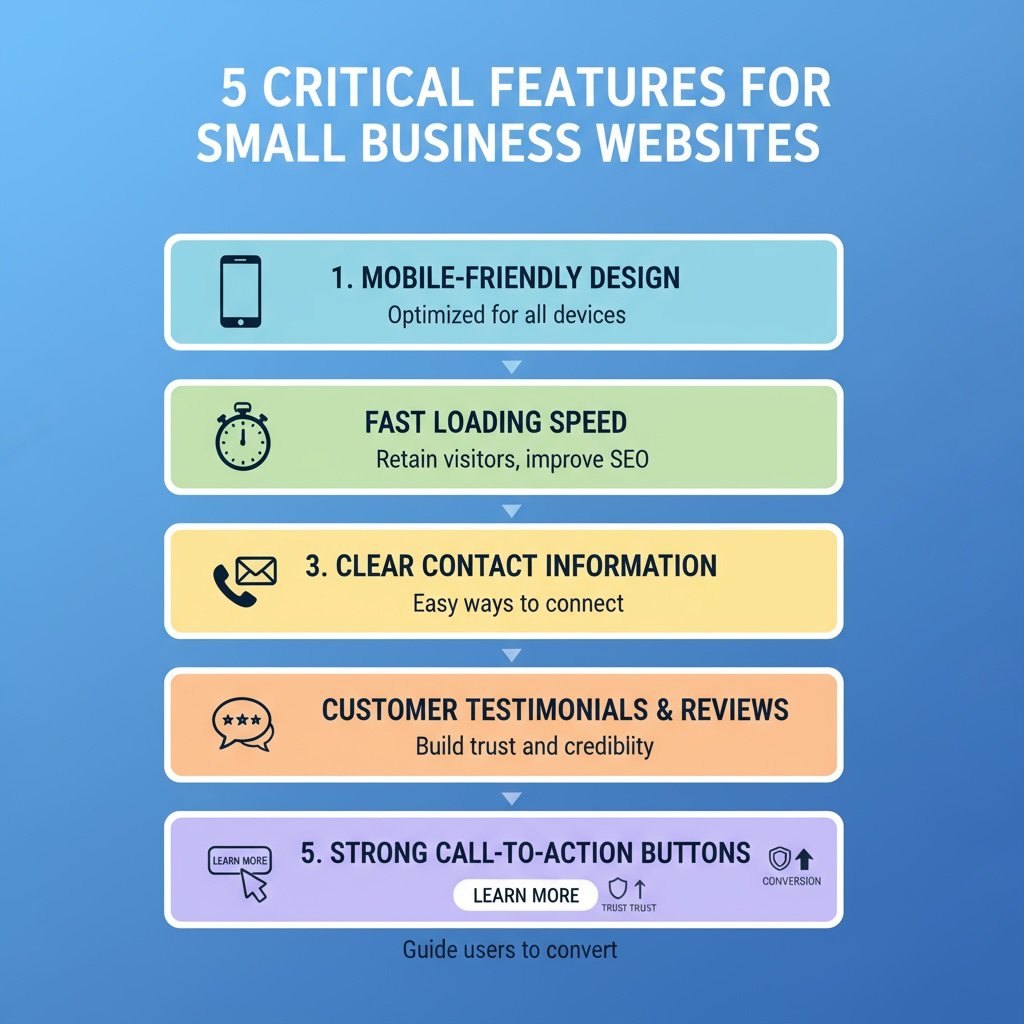
Visual guide to the 5 essential website features small businesses must have for customer trust and conversions
1. Mobile-Friendly Design
Your website must automatically adapt to any device. Responsive design isn’t luxury—it’s requirement. Test your website on iPhone and Android. Tap buttons should be easy to click. Text should be readable without pinching to zoom. Imagery should load quickly. Mobile experience directly impacts rankings and conversions.
2. Fast Loading Speed
Three seconds. That’s your window. If your website takes longer than 3 seconds to load, visitors bounce to competitors. Page speed affects rankings, user experience, and conversions simultaneously. Optimize images, minimize code, use content delivery networks (CDNs), and monitor performance regularly.
3. Clear Contact Information
Make it ridiculously easy to contact you. Phone number, email address, physical address (if applicable), and contact form should be prominently visible on every page. Mobile visitors should tap a phone number to call instantly. This removes friction from your sales process.
4. Customer Reviews & Testimonials
Social proof is powerful. Prospects reading positive reviews from previous customers are significantly more likely to convert. Google reviews, testimonials on your website, case studies, and before/after photos all contribute to credibility and conversion rate improvement.
5. Strong Calls-to-Action
Your website should guide visitors toward specific actions: “Schedule a Consultation,” “Call Now,” “Get Your Free Quote,” “Shop Now,” “Download Your Free Guide.” Ambiguous websites confuse visitors. Clear CTAs convert them.
How Websites Generate Revenue Beyond Direct Sales
Many small business owners mistakenly believe websites only generate revenue through eCommerce sales. This narrow view causes them to dismiss website value. Reality: websites generate revenue through multiple channels.
Lead Generation: A plumber’s website generates service inquiries 24/7. An accountant’s website collects tax consultation requests. A consultant’s website attracts speaking engagement opportunities. Each lead has monetary value. Your website becomes your most efficient lead generation tool.
Service Booking: Allowing customers to schedule appointments directly through your website removes scheduling friction. Clients book outside business hours. You receive notifications. Automation increases booking volume without increasing your time investment.
Product Sales: Whether you’re selling physical products, digital downloads, or online courses, your website is your storefront. 87% of small businesses selling on their websites report meaningful revenue contribution.
Subscription Revenue: Courses, memberships, premium content, and recurring services all work beautifully through websites. Monthly subscription revenue creates predictable, growing business foundations.
Affiliate Marketing & Partnerships: Websites with authority attract partnership opportunities. Brands want to collaborate with established online presences. small business website design in the USA as your website builds credibility.
The Trust Cascade: From Website Credibility to Customer Loyalty
Understanding how websites build trust helps you design better websites. The trust cascade works like this:
First Impression (0-3 seconds): Professional design creates immediate credibility. Your website is judged within seconds. Investment in quality design pays dividends here.
Content Quality (3-30 seconds): Clear messaging, relevant information, and compelling copy deepen trust. Visitors want to understand your value proposition immediately. Ambiguous websites fail here.
Social Proof (30-90 seconds): Reviews, testimonials, client logos, and case studies prove you’re legitimate. This third-party validation is powerful. Include multiple trust signals throughout your website.
Easy Navigation (ongoing): Visitors who can easily find information trust you more. Confusing website structures frustrate users and signal disorganization. Clear navigation conveys competence.
Mobile Experience (when applicable): Mobile-optimized websites convey commitment to customer experience. Mobile-unfriendly websites signal you’re outdated and don’t prioritize customer convenience.
Security Signals (throughout): SSL certificates (https), privacy policies, clear data handling practices, and security badges all contribute to trust. Visitors should feel confident their information is protected.
Call-to-Action Clarity (at conversion points): When visitors know exactly what to do next, they’re more likely to take action. Unclear next steps confuse visitors and kill conversions.
Each element compounds trust progressively. By the time visitors reach your call-to-action, they’ve formed deep credibility judgments. Websites executing this trust cascade convert at 5-10% rates. Those missing elements convert at 1-2%.
The 20-Second Credibility Audit: What Customers See
Put yourself in your customer’s shoes. When they land on your website, they’re asking these questions in rapid succession:
“Is this business legitimate?” Your design answers this. Professional = yes. Outdated or cluttered = no.
“Do they offer what I need?” Clear messaging answers this. Within 20 seconds, visitors should understand your value proposition.
“Are they trustworthy?” Testimonials, reviews, certifications, and professional appearance answer this. 83% of consumers form their trust opinion in under 20 seconds.
“Is it easy to do business with them?” Navigation, clear contact information, and obvious next steps answer this. 96% of consumers trust brands that make doing business easy.
“Are they better than alternatives?” Competitive positioning, unique value, and customer social proof answer this. What makes you different?
If your website is unclear on any of these points, you’re leaving customers confused and conversions unrealized.
ROI: Quantifying Your Website Investment
Let’s talk numbers. A professional website typically costs $5,000-$15,000 initially. Hosting, maintenance, and optimization add $1,000-$3,000 annually.
Return calculation:
- Website investment: $10,000 initial + $2,000 annual = $12,000 Year 1
- Customer acquisition: Average 20 new customers in Year 1
- Customer value: Average $1,000 per customer = $20,000 revenue
- Net Year 1 ROI: $20,000 revenue – $12,000 cost = $8,000 profit
But this analysis is too conservative. It ignores compounding benefits:
Year 2: Your website attracts 40 customers (SEO benefits compound) = $40,000 revenue – $2,000 cost = $38,000 profit
Year 3: Your website attracts 65 customers = $65,000 revenue – $2,000 cost = $63,000 profit
Five-year cumulative: Potentially $150,000+ incremental revenue from a $10,000 initial investment.
These projections assume modest growth. Optimized websites experience dramatically higher returns.
The Small Business Website Features Comparison Table
The Bottom Line: Waiting Is the Biggest Risk
If you’re still wondering whether your small business needs a website, you’re already behind. The decision isn’t whether to build a website—it’s whether to build one today or lose customers to competitors who already have. With small business website design, you can create a professional online presence that attracts customers and enhances your credibility. Investing in a well-designed website opens up opportunities for growth and allows you to showcase your products or services effectively. Don’t let budget constraints hold you back; there are many options that cater specifically to the needs of emerging businesses.
71% of small businesses are online. Your customers expect to find you there. 81% research online before purchasing. You need to be discoverable. 87% of small businesses sell on their websites. You need that revenue channel.
The competitive advantage belongs to businesses taking action now. Your website becomes better, more authoritative, and more profitable over time. Websites built in 2025 will capture years of compounding SEO benefits, customer reviews, and brand authority.
Every day your business remains offline costs you customers, revenue, and competitive position. Small businesses with websites grow 2X faster. The question isn’t ROI—it’s whether you can afford to wait.
Ready to Build Your Competitive Advantage?
Your website works 24/7 to attract customers, build trust, and generate revenue. Yet navigating design, functionality, SEO, and conversion optimization overwhelms most business owners juggling daily operations. If you would rather do it yourself, start with our guide on how to build a website on a small budget.
👉 Get your free website consultation with Affordable Web Design Agency’s affordable web design services. Our web design experts will audit your current online presence, identify revenue opportunities, and build a professional website optimized for customer trust and conversions.
👉 Let us build your competitive advantage — Get your free quote today and discover why hundreds of small business owners trust Affordable Web Design Agency to transform their online visibility and drive sustainable business growth.
Getting a site live is step one. Making it findable is step two, and most small businesses skip it. Our affordable SEO services for small businesses are built to close that gap.