The graphic design landscape has fundamentally shifted. What once required hiring expensive freelancers or maintaining an in-house creative team now exists at your fingertips through artificial intelligence. For small business owners navigating an increasingly competitive digital marketplace, understanding this revolution isn’t optional—it’s essential to staying relevant and profitable.
The AI Graphic Design Revolution is Here and Now
Artificial intelligence has transformed graphic design from a specialized skill into an accessible business tool. Generative AI platforms like Adobe Firefly, Canva’s Magic Design, and Midjourney have shattered traditional barriers that kept professional-quality design cheap web design. Remarkably, the technology itself proves less significant than the measurable business impact it delivers.
The numbers tell a compelling story. According to recent research, 85% of small and mid-sized businesses using AI expect clear return on investment within their first year. More dramatically, small businesses that adopted AI photography tools in 2025 reported cost savings exceeding 80%, with some achieving reductions as high as 95% compared to traditional design methods.
These aren’t theoretical gains—real small business owners across the UK and US are already leveraging these tools to compete with enterprise-level companies while maintaining lean operational budgets.
Time Efficiency: From Weeks to Hours
Here’s where AI hits hardest: speed that fundamentally changes how businesses operate.
Across all tasks, generative AI reduces average completion time by more than 60%, with highly creative tasks showing even more dramatic improvements. Subsequently, for graphic design specifically, this translates into concrete advantages:
Traditional logo design projects consumed 2-4 weeks and cost £1,500-£5,000. In contrast, AI tools generate professional-quality logos in minutes for £20-£100. What previously required multiple revision cycles and designer availability now happens in real-time, with unlimited variations accessible instantly.
Design timelines have contracted dramatically—from weeks into hours. Consequently, a complete brand identity package that traditionally consumed 3-10 weeks now emerges in a single working day—91% faster than conventional methods. For small business owners juggling multiple responsibilities, this acceleration represents genuine competitive advantage.
Consider the practical reality: Instead of waiting two weeks for a designer to complete three social media banner variations, you generate 30 variations in 20 minutes, test them immediately across platforms, and implement winners before your competitor even commences their design brief.
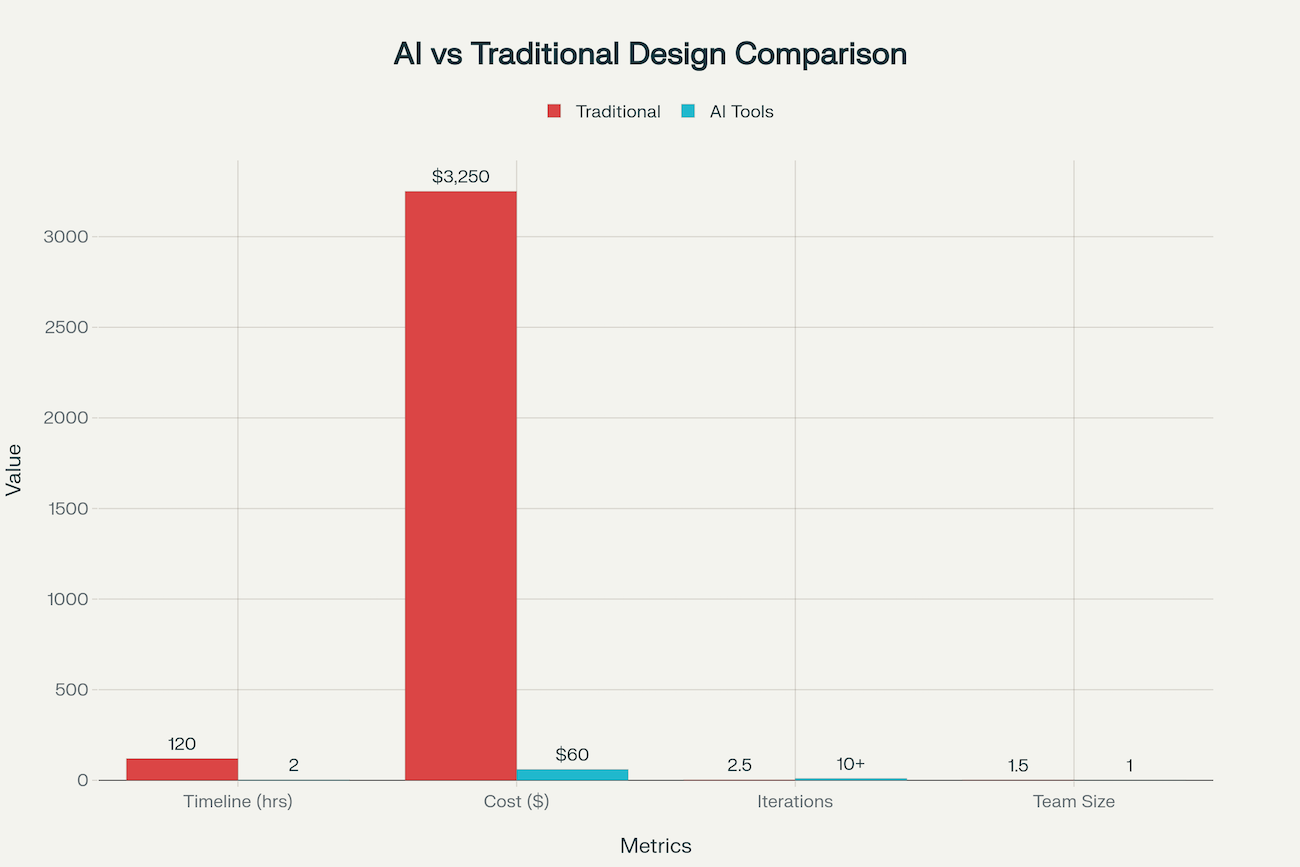
AI vs Traditional Graphic Design: The Game-Changing Difference for Small Business Owners
Cost Revolution: Reclaiming Your Budget
The financial transformation proves even more striking than timeline compression.
Traditional brand design through agencies costs £3,000-£10,000 for basic packages. Meanwhile, AI-powered solutions deliver equivalent results for £50-£300. Product photography—historically consuming £150-£400 per image—now emerges from AI systems for pennies. Small businesses aren’t simply saving money; they’re redirecting resources toward growth opportunities previously inaccessible due to design budgets.
This economic reality creates genuine disruption. Smaller operations now produce visuals rivaling established competitors without the corresponding overhead. Notably, marketing automation—the highest ROI application of AI across all business functions—delivers returns of £5.44 for every pound invested.
The practical implications extend beyond cost per asset. Additionally, businesses previously constrained by design budgets now execute more ambitious campaigns. Rather than limiting you to four campaign variations annually, AI enables quarterly refreshes or even monthly content iterations. Ultimately, this frequency advantage directly impacts customer engagement and conversion rates.
Democratization: Design Expertise You Don’t Need
One profound shift often overlooked: AI has democratized professional-quality graphic design.
Historically, producing polished visuals required formal design training. Today, however, Canva’s AI tools suggest layouts, Designs.ai automates multi-format content creation, and Adobe Firefly handles complex image manipulations through simple text prompts. Non-designers now execute work that previously demanded hired professionals.
Consequently, this accessibility transforms small operations. Your marketing coordinator produces social media assets without external support. Furthermore, your founder generates brand concepts during initial planning. Your customer service team creates visual responses to inquiries. These aren’t compromises—they’re professional-quality outputs generated by people focused on business problems rather than design mechanics.
Research demonstrates this accessibility matters significantly. Among over 400 graphic designers surveyed, 98% reported their workflows changed due to AI integration, with 91% citing positive ROI from adoption. Perhaps more tellingly, 95% of small and medium businesses now effectively use generative AI as part of their daily operations.
Strategic Advantages in Real Business Scenarios
Let’s translate this into concrete business situations where small business owners compete daily:
E-commerce product photography previously consumed significant resources. Professional photography required studio rental, props, lighting equipment, and photographer fees. However, AI product photography eliminates this entirely, generating studio-quality images from basic product shots in seconds. Small e-commerce operators now match large retailers’ visual presentation while maintaining healthy margins.
Marketing campaign timelines previously limited responsiveness. Social media opportunities emerge and disappear rapidly. Evidently, traditional design workflows couldn’t accommodate this velocity. Conversely, AI enables real-time campaign adaptation—tests variations, measures performance, and implements winners within hours rather than weeks.
Brand consistency previously required expensive oversight. Ensuring every asset maintained brand standards demanded designer review and revision. Today, AI brand templates enforce consistency automatically, maintaining color palettes, typography, and visual language across all outputs without manual intervention.
| Business Challenge | Traditional Approach | AI-Powered Solution | Business Impact |
|---|---|---|---|
| Product photography | £3,000-8,000/shoot | Minutes per image | Continuous catalog refreshes possible |
| Logo design | 4-6 week timeline | 30-minute turnaround | Launch faster, test variations instantly |
| Social media content | Weeks for campaign | Hours for dozens of variations | 10x more testing and optimization |
| Brand consistency | Manual review process | Automated template application | Zero brand violations, 100% consistency |
| Design revisions | 3-5 rounds over weeks | Unlimited iterations instantly | Perfect output without timeline pressure |
Real Statistics Small Business Owners Should Know
Understanding the business case behind AI adoption matters considerably. Here’s what the data reveals:
Time Impact: Employees using AI report saving 52 minutes daily—nearly five hours weekly. For small teams wearing multiple hats, this translated time represents substantial capacity increase without additional hiring.
Productivity Gains: Generative AI achieves 40% average productivity improvement when workers combine familiarity with experimentation. Additionally, technical tasks show even higher improvements, with programming and design work seeing 56-76% time reductions.
Marketing Effectiveness: Marketing automation—the primary AI application for small business—delivers £5.44 return for every pound invested, generating 451% increases in qualified leads and 77% higher conversion rates.
Widespread Adoption: Daily AI usage increased 233% within six months during 2024. Clearly, this isn’t emerging technology—it’s rapidly becoming standard business practice.
Quality Parity: 76% of small businesses adopting AI photography tools achieved 80%+ cost savings while maintaining or improving output quality. Simultaneously, this improves bottom-line economics and visual competitiveness.
Key AI Tools Transforming Small Business Design
Understanding available options helps with selection. Here’s what leads the market:
Canva AI specializes in accessibility and speed. Magic Resize automatically adapts designs across formats, while AI template suggestions accelerate project initiation. Ideally suited for teams without design experience prioritizing campaign velocity over artistic originality.
Adobe Firefly embeds AI directly into Photoshop and Design Suite, enabling designers to work within existing workflows. Text-to-image generation, generative fill, and automatic color recoloring streamline professional workflows effectively.
Midjourney excels at generating distinctive, art-forward visuals—particularly valuable for creating distinctive mood boards and branded photography.
Designs.ai handles multi-format production from single brand specifications, automatically resizing for Instagram, LinkedIn, YouTube, and print. Particularly valuable for campaign consistency across platforms.
Google AutoDraw remains free, converting rough sketches into refined illustrations—an accessible entry point for businesses testing AI design capabilities without budget commitment.
The selection strategy matters less than starting implementation. Ultimately, most small business owners benefit most from platforms requiring zero design training—typically Canva or Designs.ai—before exploring specialized tools.
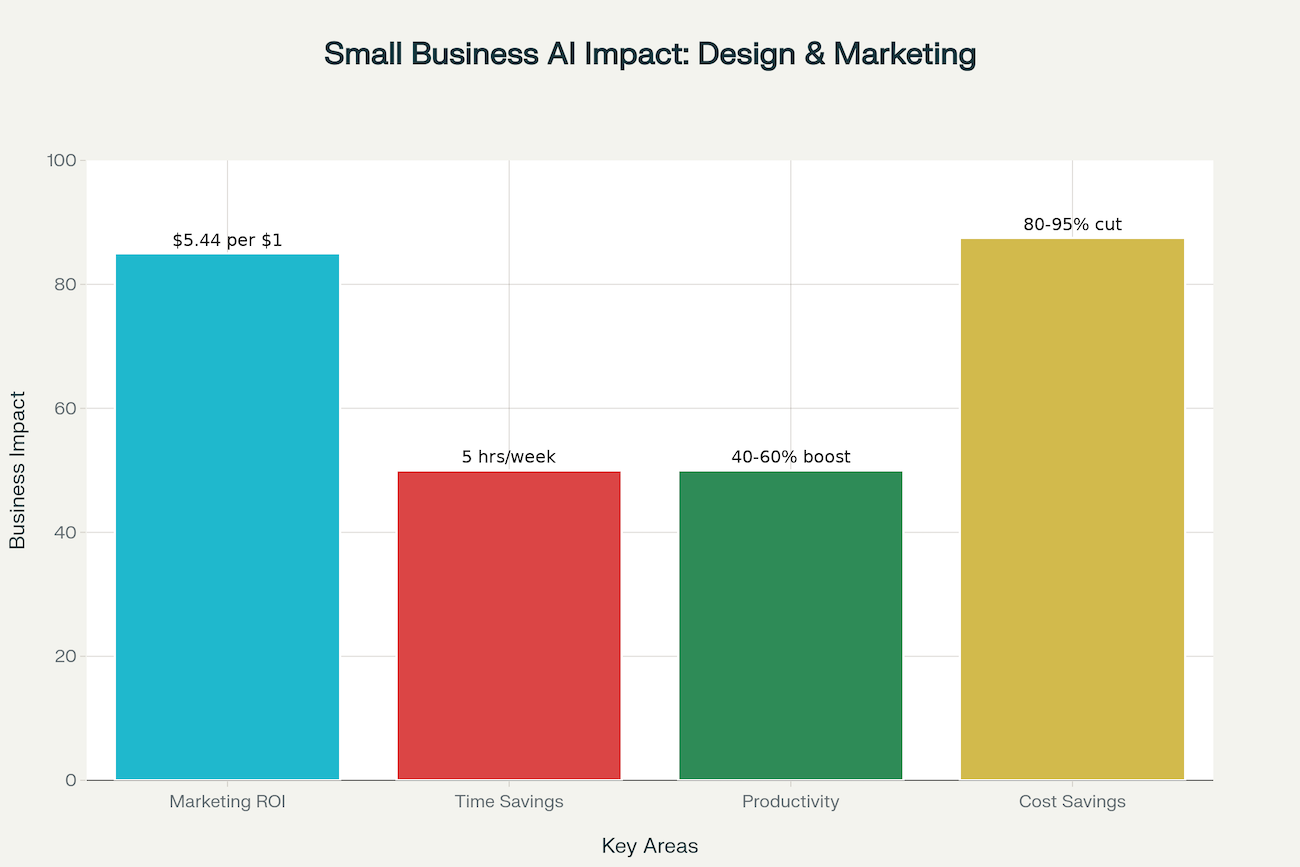
AI Graphic Design ROI: Measurable Impact on Small Business Performance
Addressing the Inevitable Concerns
Reasonable questions surface when businesses consider AI adoption. Let’s address the most common concerns:
Quality Assurance: Will AI-generated designs meet professional standards? Current research demonstrates unequivocal affirmation. When properly prompted, contemporary AI tools generate outputs indistinguishable from professional design work. Importantly, human oversight still matters. AI creates the asset; you ensure it aligns with brand vision and business objectives.
Brand Consistency: Does automation guarantee consistent brand application? Yes, it does. Brand kit features—storing approved colors, logos, and typography—enable AI to enforce consistency automatically across all outputs. Significantly, this actually exceeds most small business capabilities with traditional freelancers or part-time designers.
Learning Curve: How long before my team uses these tools productively? Most modern AI design platforms prioritize intuitive interfaces. Canva, for instance, requires no training—most users become productive within minutes. Moreover, more sophisticated tools like Adobe Firefly typically require 1-2 hours of experimentation.
Competitive Obsolescence: If AI design democratizes access, won’t everyone look the same? This raises interesting questions about differentiation, but the reality differs. Effective design distinguishes through strategic choices—appropriate tone, audience targeting, and market positioning—not execution complexity. Therefore, AI handles execution beautifully; your brand vision remains the differentiator.
What This Means for Your Small Business Trajectory
The competitive landscape has fundamentally shifted. Historically, design capability correlated with budget—larger budgets hired better designers, creating visual advantages. This correlation has severed.
Today, strategic thinking and consistent execution differentiate. An owner understanding their brand and audience, leveraging AI tools effectively, now outcompetes competitors with larger budgets but less deliberate positioning.
Moreover, the time freed through AI automation redirects toward higher-value activities. Rather than managing design projects, leadership addresses strategy, customer relationships, and growth initiatives. Ultimately, this is where competitive advantage genuinely compounds.
For small business owners specifically, this moment represents genuine democratization. The playing field has legitimately leveled. Professional-quality visual marketing previously accessible only to well-funded operations now exists within reach of any determined entrepreneur.
Your Path Forward
Implementation needn’t be complex. Most successful small businesses begin with a single AI tool addressing their most pressing design challenge. An e-commerce business might start with product photography AI. Alternatively, a service business might begin with social media content generation. Similarly, a manufacturing business might prioritize marketing asset creation.
Start narrow. Pick the tool addressing your highest-impact problem. Experiment relentlessly. Measure outputs against your existing work. Most teams reach productive proficiency within one week of consistent experimentation.
The AI graphic design revolution isn’t approaching—it’s actively reshaping how competitive small businesses operate. Ultimately, the question isn’t whether to participate, but when to begin.
Ready to revolutionize your visual marketing while dramatically reducing costs? Discover how affordable web design services can integrate AI-powered graphic design into your complete digital presence. One of the key offerings includes small business website design, providing tailored solutions that enhance user experience and engagement. By leveraging innovative design strategies, these services empower new businesses to establish a strong online identity without breaking the bank. As a result, startups can focus on growth and development while their digital presence captures attention and drives conversions.
👉 Get your affordable web design services — combining professional design strategy with cutting-edge AI automation for maximum impact and minimum investment.
Ready to transform your visual marketing today?
👉 Get your free quote — Let us build your comprehensive visual strategy, leveraging AI tools to deliver professional results without the traditional agency price tag.